
Arzi
Every upload, right the first time
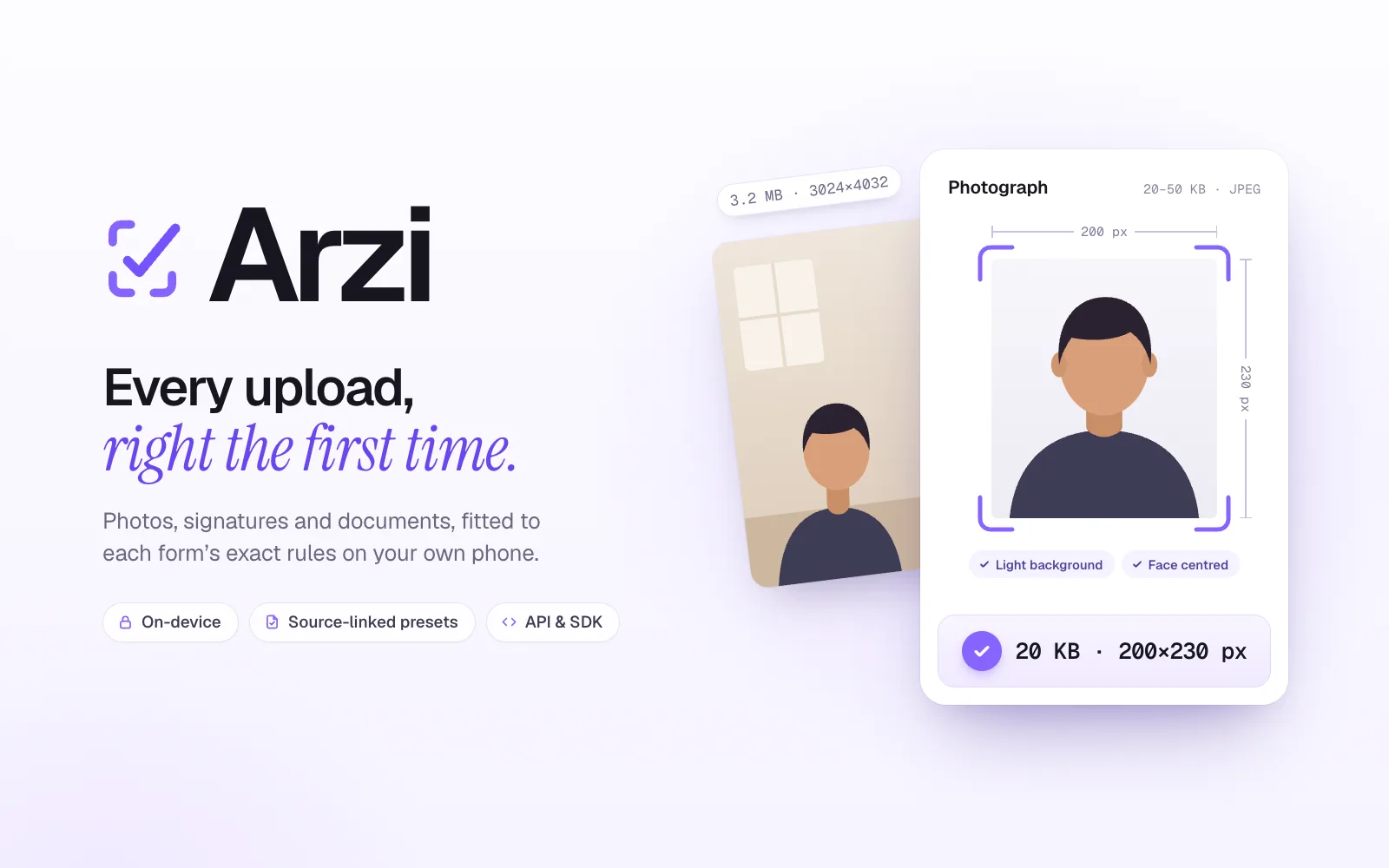
I'm building Arzi so that a photo, a signature or a certificate is right for the form before it's uploaded. You pick the form, and Arzi fits the file to that form's published rules on your phone: the exact pixels, the KB range, the crop, the background, a clean signature. It's in development, and I'm looking for partners to build it with.
- Stage
- In development
- Platforms
- Web · WhatsApp · Android · Browser extension · API and SDK
- Stack (planned)
- TypeScript · Next.js · WebAssembly · MediaPipe · PostgreSQL
- Model
- Free for people · paid API, SDK and desk plans for institutions
- Privacy
- Fitted on the device; WhatsApp files deleted after the reply
- Partnership
- Sponsorship with perks, not equity
One photo, a hundred rulebooks
Almost every online application in India asks for the same few files: a photo, a signature, sometimes a thumb impression, a handwritten declaration or a certificate. Every form has its own rulebook for them.
The IBPS notification for its 2025 Probationary Officer recruitment asks for six:
| File | What the notification asks for |
|---|---|
| Photograph | 200 × 230 px preferred, 20–50 KB, colour, light background |
| Live photograph | Captured with a webcam or phone during registration |
| Signature | 140 × 60 px preferred, 10–20 KB, not in capital letters |
| Left thumb impression | 240 × 240 px at 200 DPI, 20–50 KB |
| Handwritten declaration | 800 × 400 px at 200 DPI, 50–100 KB, not in capital letters |
| Class 10 certificate | PDF, A4, up to 500 KB |
It is plain about the stakes. Until the photo and signature match, "the system will not allow the candidate to move forward", and an application without every file "will not be registered" (IBPS).
Change the form and the rulebook changes. SSC's application module takes a live photo on the spot, with its own rules: no cap, no mask, no glasses (Careers360). A US visa wants a square JPEG of 600 to 1,200 px, no larger than 240 kB (US State Department).
The size of the queue
Six national exams took close to 2 crore applications in their 2025 cycles, each with at least a photo and a signature:
| Exam, 2025 cycle | Applications | Reported by |
|---|---|---|
| RRB Group D (CEN 08/2024) | 1.08 crore | trak.in |
| SSC CGL | 28.15 lakh | Careers360, quoting SSC |
| NEET UG | 22.76 lakh | Scroll |
| JEE Main, session 1 | 13.78 lakh | Careers360 |
| CUET UG | 13.55 lakh | Careers360 |
| UPSC Civil Services (prelims) | 9.3 lakh+ | All India Radio, quoting UPSC |
That's about 1.96 crore applications, or 19.6 million (a lakh is 100,000; a crore is 10 million), before state commissions, police and bank recruitment, admissions, scholarships, visas, KYC and job onboarding.
Wrong files at that scale are expensive. In one Railway Group D recruitment, 4,85,607 applications were rejected for an invalid photo and/or signature, and the railways opened a modification link so those candidates could upload again (Swarajya). Each one costs someone: the candidate who has to fix it, the cyber café that does the job twice, and the exam body that runs the correction window and the helpline.
What people use today
Search for "resize photo to 20 KB" and you'll find dozens of tools. On Google Play, exam-photo resizers run from about a hundred installs to over 100,000, and one says it covers 400+ exams and documents. Some web tools, like ExamMint's, already work inside the browser.
They prove the demand, and they show what's missing:
- They fix the size, not the rules. A file can be exactly 20 KB and still fail: the face too small, a grey background, a dark photo, a signature in capitals.
- Their presets aren't sourced. Specs change with every notification. A preset that doesn't link to the official PDF, and say when it was checked, is a guess.
- They arrive after the error. Nothing sits where the upload happens: in the portal, the coaching app or the onboarding form.
- They serve one person at a time. A cyber café that fills forms all day, or an HR team onboarding hundreds of people, has nothing made for them.
What Arzi does
Arzi (अर्ज़ी, عرضی) is the Hindi and Urdu word for a written application. The product turns the file you have into the file your application asks for, and shows you why it passes.
- Pick the form: IBPS PO, NEET UG, a US visa, a company's onboarding form. Each one is a preset in Arzi's library.
- Add the file: a new photo, one from the gallery, or a scanned page.
- Arzi fits it. It crops to the face the way the rules describe, evens out the background, lifts a signature off the paper, adds a name-and-date strip when a form wants one, and lands the exact pixels and KB range. Several pages become one PDF under the limit.
- You get a report, not a hope: each rule, the measured value, pass or fail, and a link to the notification the rule came from.
The same engine, in four places:
- A web app that works on any phone, and offline once it has loaded.
- A WhatsApp number: send a photo, name the form, get the fitted file back.
- A browser extension that recognises upload fields on supported portals.
- An API and SDK for institutions: a drop-in upload field that checks and fits files before they're submitted.
How it works
- The preset library is a versioned, machine-readable record of each form's rules: dimensions, KB range, format, DPI, background, how much of the frame the face fills, signature style, the name-and-date strip. Each preset links to its official notification and records when it was last checked. When a rule changes, the preset gets a new version and the old one stays on record.
- The fitting engine runs on the device, in WebAssembly. A search over JPEG quality and dimensions lands each file inside its KB window instead of guessing. On-device models find the face and the background, and plain image processing lifts ink off paper.
- The checker reads a finished file against a preset and returns a report a person can read and a system can trust, down to the preset version.
Files stay on the phone. In the web app, the extension and the SDK, nothing is uploaded to a server. WhatsApp is the exception, because the photo has to travel: there, files are processed in memory and deleted as soon as the fitted file goes back.
The stack listed at the end of this page is the plan, not a finished build: TypeScript and Next.js for the web app, WebAssembly codecs (MozJPEG and libvips) and MediaPipe for the engine, pdf-lib for PDFs, PostgreSQL for the preset library, the WhatsApp Cloud API, and Flutter for Android.
Why now
- The photo has to get past a camera now. SSC takes a live photo in its application module, and in January 2026 UPSC made face authentication at the venue mandatory, matching each face against the photo on the application (Careers360).
- People apply on phones, often borrowed ones. India had 886 million active internet users in 2024, and one in five relied on someone else's mobile to get online (MediaNama, on the IAMAI–Kantar report). It has to work on a low-end Android phone, in Indian languages, on a weak connection.
- Privacy is law. The Digital Personal Data Protection Rules, 2025 were notified in November 2025, and most of their duties apply 18 months later (PTI, via The Week). A file fitted on the candidate's own phone never becomes another copy someone has to protect.
- The phone can do the work. Face detection, background separation and fast image codecs now run well in a mobile browser, so the private version is also the fast one.
Where it stands
Arzi is in development: there are no users and no revenue yet, and three early supporters are backing the build. The plan, in order:
Phase 1: the engine and the web app. The fitting engine, the checker, presets for the national exams (UPSC, SSC, IBPS, SBI, the RRBs and NTA) and the common ID and visa photos, and a web app that works offline on a low-end Android phone. Free for people.
Phase 2: where people already are. The WhatsApp number, the browser extension, an Android app, and Hindi first among Indian languages. A desk mode for cyber cafés and Common Services Centres: a queue of applicants, batch fitting and print-ready sheets.
Phase 3: inside the institutions. The API and SDK for exam portals, coaching platforms, HR and onboarding tools, KYC flows and universities, with presets kept up to date with the institution itself, signed check reports, and pricing per checked upload.
Who pays
People never pay to fit their own photo. The organisations that lose time to bad uploads do:
- Exam-prep platforms and coaching chains, which already publish photo and signature guides for each notification (PracticeMock, PW).
- Cyber cafés and Common Services Centres, which fill in forms for a living. There were 5,97,441 functional CSCs in January 2025 (Rajya Sabha).
- HR and onboarding tools, where every new hire uploads a photo, ID and certificates.
- Banks, NBFCs and fintechs, whose KYC needs documents that are readable and complete.
- Universities and exam bodies, which run correction windows and helplines. Higher-education enrolment in India was 4.33 crore in 2021–22 (AISHE).
It isn't only India's problem (the US State Department runs its own photo tool for visa applicants), but India is where I'll start.
Partner with me
I'm not raising investment. I'm looking for partners who fund a year of building and get real things back. It's sponsorship with clear perks, not equity: no shares and no share of revenue.
The goal is $30,000, for one year of:
| What it pays for | Amount |
|---|---|
| Build: focused time on the engine, the web app and the WhatsApp number, plus help on the Android app | $14,000 |
| Preset upkeep: a part-time researcher who tracks notifications and re-checks every preset | $5,000 |
| Design: the brand, the product UI and the guided capture flow | $4,000 |
| Infrastructure: hosting, the preset database, WhatsApp fees and monitoring | $3,000 |
| Legal: company registration, the trademark, and privacy terms written for the DPDP Rules | $3,000 |
| A security review, and low-end Android phones for testing | $1,000 |
Supporters start at $50, founding partners at $1,500 and strategic partners at $7,500. Each tier's perks (early access, your name on the presets you care about, API credit, a seat in shaping the roadmap) are listed below.
If you run an exam-prep platform, a coaching chain, a network of cyber cafés, an HR or onboarding product, a KYC flow or an admissions office, write to me and tell me which forms you'd want first.
Highlights
- On-device by design: in the web app, the extension and the SDK, photos and documents never leave the phone
- Every preset links to the official notification it came from and records when it was last checked
- Every fitted file comes with a report: each rule, the measured value, pass or fail
- One engine behind a web app, a WhatsApp number, a browser extension, an Android app and an SDK
- A desk mode for the cyber cafés and Common Services Centres that fill in forms for other people