
Archive · AI & automation
AI Integration Feasibility Analyzer
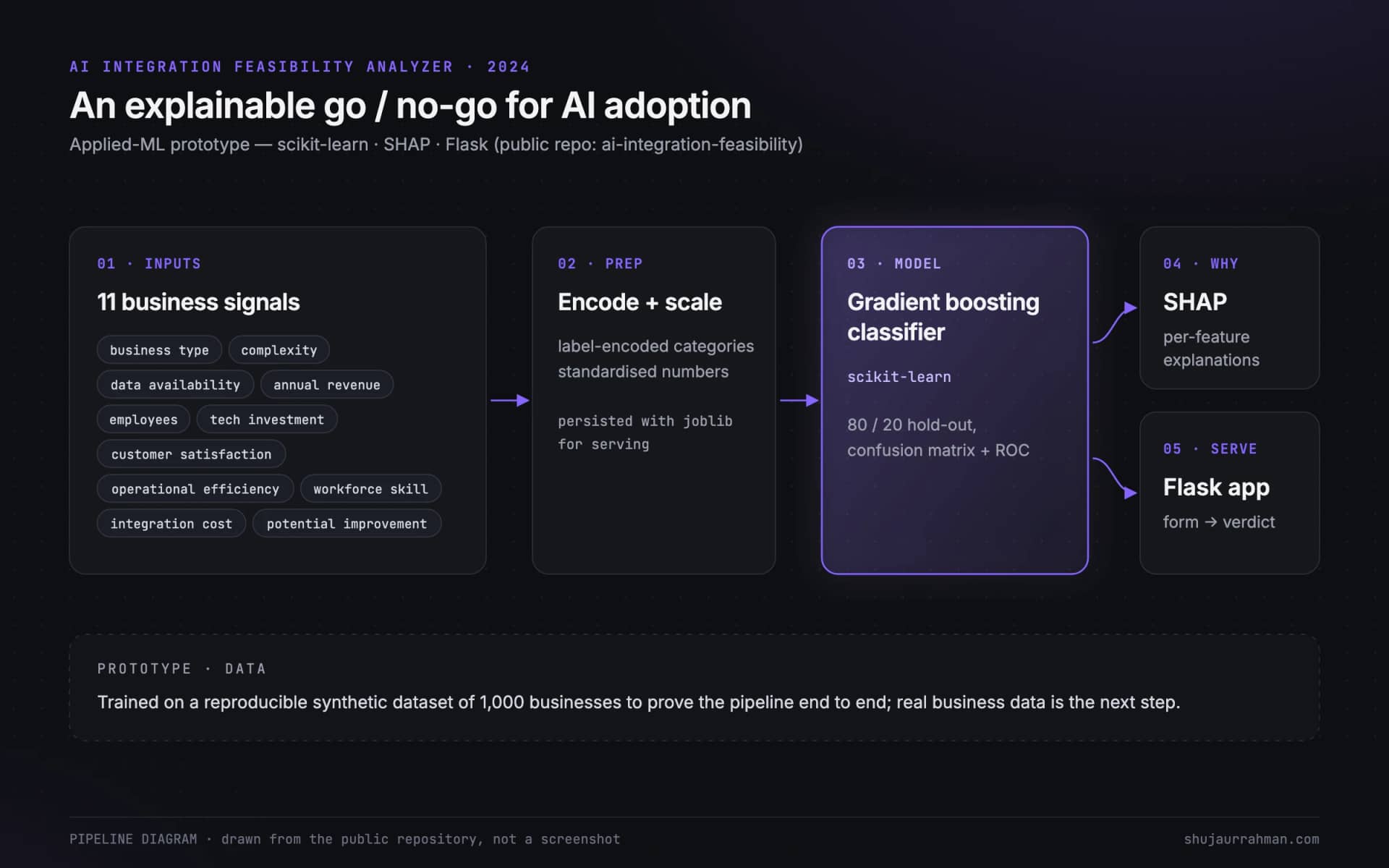
An AI-adoption predictor with SHAP explanations, built with scikit-learn and Flask. A gradient-boosting classifier scores 11 business signals, and SHAP shows which of them drove each verdict. It is a prototype trained on a synthetic dataset of 1,000 businesses.
01 · Overview
Should this business invest in AI yet?
The AI Integration Feasibility Analyzer is a prototype built around one question: would integrating AI help a business at its current stage? It takes 11 signals about the business, among them its type, data availability, annual revenue, workforce skill, integration cost and potential improvement. It returns a yes or no, with the reasons behind it.
I built it alone in November 2024, from the dataset to the Flask app. The code is public on GitHub.
- Role
- Solo
- Type
- Applied-ML prototype
- Timeline
- Nov 2024
- Model
- Gradient boosting (scikit-learn)
- Explainability
- SHAP
- Data
- Synthetic, 1,000 businesses
02 · The pipeline
Encode, scale, boost, explain
- Prepare. Categories are label-encoded and numbers standardised, then persisted with joblib so the app can reuse them.
- Model. A scikit-learn gradient-boosting classifier, evaluated on an 80/20 hold-out with a confusion matrix and an ROC curve.
- Explain. SHAP values show how far each signal pushed a prediction, so the verdict comes with its reasons.
- Serve. A Flask app takes the 11 answers in a form and returns the verdict from its
/predictroute.
Stack
PythonpandasNumPyscikit-learnSHAPFlaskjoblibmatplotlibseabornGoogle Colab